Carpets
Brief History of Kashmir Carpets
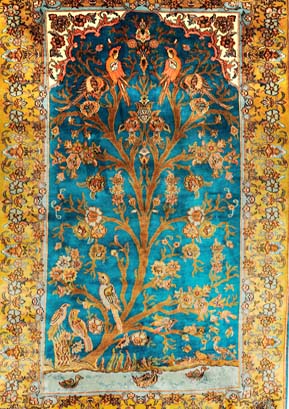
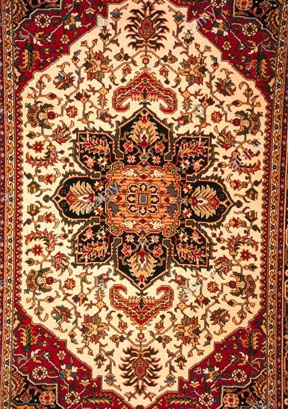
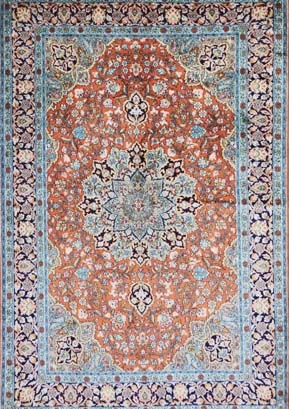
The origin of hand knotted carpets locally known as “Kal baffi” dates back to 15th century after which it progressively attained the high degree of perfection. It is said that Sultan Zain-ul-Abidin brought carpet weavers from Persia and central Asia in to Kashmir to train the local inhabitants. A carpet is a life long investment. Kashmiri carpets are world renowned for two things. They are hand made and they are always knotted, never tufted. It is extremely fascinating to watch a carpet being made. The warp of the carpet is strengthened tightly on a frame. The weft threads are first passed through the “talim” the design or the colour specifications. Then a strand of yarns is looped through the warp and weft, knotted and then cut. The yarn normally used is silk, wool or silk and wool. Woollen carpets always have a cotton base (warp and weft).
Quality and hence value, is determined by the number of knots to the square inch and fineness of the material used.
The Kashmiri carpet became a prized possession because of its soft colours. Silk carpets usually have a cotton base. Sometimes however, the base is also silk in which case one can see that the fringe is silk. Occasionally, carpets are made on a cotton base,
Kashmir carpets usually come in the sizes of 2’x3′; 2 1/2’x4′; 3’x5′; 6’x4′; 6’x9′;
Showing all 10 results